Types of Microphones: 7 Types and Their Uses
Published: 7 Oct 2026
A microphone is a device that captures sound and turns it into an electrical signal that can be recorded, amplified, or sent to another device. You can find microphones in smartphones, computers, cameras, studios, stages, classrooms, and many other places.
Not every microphone is designed for the same job. Some are better at handling loud sounds, while others are made to capture small details. Some work well in noisy rooms, while others perform better in quiet recording spaces.
In this guide, we’ll explore the main types of microphones, including dynamic, condenser, ribbon, USB, lavalier, shotgun, and boundary microphones. We’ll also explain pickup patterns, connection types, and how to choose the right microphone for different situations.
What Are Microphones?
A microphone captures sound and converts it into an electrical signal that can be recorded or played through speakers. Its diaphragm responds to sound waves, while different designs affect sensitivity, detail, and sound handling.
The main types of microphones include dynamic, condenser, and ribbon. USB, lavalier, and shotgun microphones are categorized by their connection, design, or intended use.
How Microphones Work
When someone speaks, sings, or plays an instrument, the sound creates waves that travel through the air. These waves reach the microphone and cause its diaphragm to move.
The microphone converts that movement into an electrical signal. Audio equipment can then process or record the signal so you can hear the original sound.
The basic process is:
- Sound waves travel through the air.
- The diaphragm moves in response to those waves.
- The microphone creates an electrical signal from that movement.
- The audio output is sent to a recorder, computer, mixer, camera, or other device.
Types of Microphones
Microphones can be classified in several ways, which can make the different types of microphones confusing for beginners. A microphone may be classified by its transducer type, physical design, pickup pattern, or connection method.
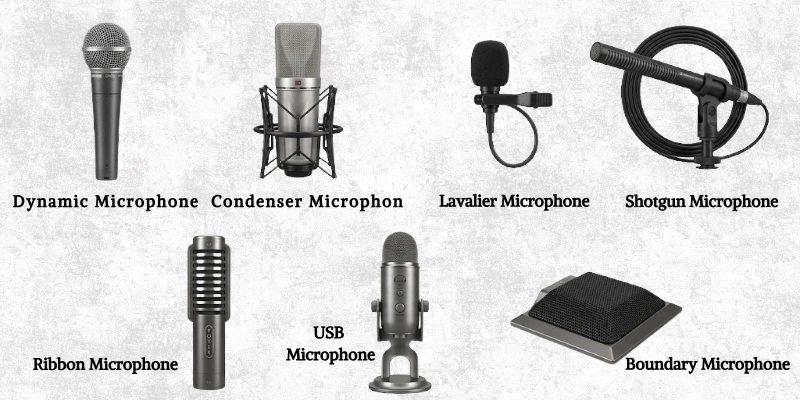
For example, a USB microphone can use a condenser or dynamic design. Similarly, a shotgun microphone describes a highly directional design, while cardioid refers to its pickup pattern.
Understanding these categories makes it easier to compare microphones and choose the right one for a particular recording situation.
Dynamic Microphones
A dynamic microphone uses a diaphragm, voice coil, and magnet to convert sound into an electrical signal. Its relatively simple construction makes it durable and suitable for many demanding situations.
Dynamic microphones are generally less sensitive than condenser microphones. This can be useful when you are recording in a room with unwanted background noise because they tend to focus more on sounds close to the microphone.
Best for: live vocals, podcasts, loud instruments, and less-controlled rooms.
Condenser Microphones
A condenser microphone is designed to capture a high level of detail. It uses an electrically charged diaphragm system that responds quickly to changes in sound.
This sensitivity allows condenser microphones to capture subtle parts of a voice or instrument. That is one reason they are common in studios and other controlled recording environments.
Best for: studio vocals, music recording, acoustic instruments, streaming, and controlled environments.
Ribbon Microphones
A ribbon microphone uses a very thin metal ribbon suspended between magnetic poles. The ribbon moves when sound waves reach it, creating an electrical signal.
Ribbon microphones are known for a warm and natural sound. They can be useful when you want a recording with a smooth character rather than an extremely bright or sharp sound.
Best for: vocals, guitar amps, brass, and studio recording.
USB Microphones
A USB microphone connects directly to a computer or another compatible device through a USB connection. It usually contains the necessary electronics to convert the microphone’s signal into digital audio.
This makes setup simple because you do not normally need a separate audio interface. Plug it in, select it as your audio input, and you can start recording.
Best for: beginners, podcasting, streaming, online meetings, and home recording.
Lavalier Microphones
A lavalier microphone is a small microphone designed to clip onto clothing. It is sometimes called a lapel microphone.
Its small size allows the person speaking to move around without holding a microphone. Lavalier microphones are available in both wired and wireless versions.
Best for: interviews, presentations, videos, lectures, and hands-free recording.
Shotgun Microphones
A shotgun microphone is designed to pick up sound primarily from the direction it is pointed. Its long shape and acoustic design help reduce sound coming from the sides.
This makes it different from a typical handheld microphone. A shotgun microphone can often be positioned near the subject without needing to be directly in front of the speaker.
Best for: filmmaking, video production, interviews, and capturing dialogue from a distance.
Boundary Microphones
A boundary microphone is designed to work when placed on a flat surface such as a table, floor, or stage. Its flat or panel-style shape allows it to sit close to the surface.
This design can make it useful for capturing conversations from several people in the same area. You may see boundary microphones in conference rooms, meeting spaces, classrooms, and stages.
Best for: conference rooms, meetings, stages, and group discussions.
Microphones by Pickup Pattern
A microphone’s pickup pattern describes the directions from which it captures sound. When learning about different types of microphones, remember that a pickup pattern is separate from the microphone’s main technical type.
For example, a condenser microphone can have a cardioid pattern, while a dynamic microphone can also have a cardioid pattern. The microphone type describes how it works, while the pickup pattern describes where it listens.
Omnidirectional
An omnidirectional microphone picks up sound from all directions around the microphone. It does not strongly favor the front, back, or sides.
This can be useful when you want to capture the surrounding environment or when the sound source can move around the microphone.
Cardioid
A cardioid microphone mainly picks up sound from the front while reducing sound from the rear. Its pickup area is roughly heart-shaped when viewed from above.
This pattern is popular because it can help separate the main sound source from some unwanted noise behind the microphone.
Supercardioid
A supercardioid pattern has a narrower front pickup area than a standard cardioid pattern. It also has a small amount of sensitivity toward the rear.
This tighter pickup can help when you need more focus on a particular sound source. However, correct positioning becomes more important because the microphone is less forgiving of movement.
Hypercardioid
A hypercardioid microphone has an even more focused front pickup pattern. It also has a slightly stronger rear pickup area than some other directional patterns.
This design can be useful when isolating a sound source is important. As with supercardioid microphones, placement matters because sounds outside the main pickup area may be reduced rather than completely removed.
Bidirectional
A bidirectional microphone picks up sound from both the front and rear while reducing sound from the sides. Its pickup pattern is commonly described as a figure-eight.
This can be useful when two sound sources are positioned on opposite sides of the microphone.
Microphones by Connection
Connection type is another category that beginners often confuse with microphone technology. When comparing types of microphones, remember that USB or XLR mainly tells you how the microphone connects to other equipment, not necessarily how its transducer works.
USB Microphones
USB microphones connect directly to compatible computers and devices. They usually handle the analog-to-digital conversion inside the microphone itself.
This makes them convenient for people who want a simple setup without purchasing a separate audio interface. They are especially popular for home recording, meetings, podcasting, and streaming.
XLR Microphones
XLR microphones use an XLR connector and normally connect to an audio interface, mixer, recorder, or other compatible equipment.
This setup gives users more flexibility when building an audio system. It is common in professional recording, live sound, broadcasting, and advanced home studios.
Dynamic vs Condenser vs Ribbon
Dynamic, condenser, and ribbon microphones differ mainly in their construction and how they respond to sound. Understanding these types of microphones can help you choose the right option based on your recording situation rather than expecting one microphone to work for everything.
| Feature | Dynamic | Condenser | Ribbon |
| Sensitivity | Lower | Higher | Moderate |
| Durability | High | Moderate | More delicate |
| Detail | Good | Very high | Smooth and natural |
| Loud sources | Excellent | Good | Depends on model |
| Typical use | Live & podcasting | Studio recording | Studio & instruments |
| Power | Usually no phantom power | Usually needs power | Passive models usually don’t |
In simple terms, dynamic microphones are often a practical choice for loud sources and less-controlled spaces. Condenser microphones are useful when you want to capture more detail, especially in a controlled room.
Ribbon microphones are often chosen for their smooth and natural character. However, modern designs can vary considerably, so checking the manufacturer’s specifications is important.
Which Microphone Type Is Best?
There is no single microphone that works perfectly for every situation. The best choice among the different types of microphones depends on what you are recording, where you are recording, and the conditions around you.
For Podcasting
A dynamic microphone can be a good choice for podcasting, especially when the recording room is not acoustically treated. It can help keep attention on the speaker rather than the surrounding environment.
A condenser microphone can also work well in a quiet, controlled room. Beginners who want a simple setup can consider a USB model.
For Singing
Dynamic microphones are commonly used for live singing because they can handle strong vocals and regular stage use.
For studio recording, a condenser microphone can capture more vocal detail. The singer’s voice, room, microphone placement, and desired sound all affect the final choice.
For Streaming
USB condenser and USB dynamic microphones are both common choices for streaming. USB models can make setup easier because they connect directly to a computer.
If your room has fans, traffic, conversations, or other background sounds, a microphone with a suitable directional pattern can be helpful.
For YouTube
The best choice depends on how you record your videos. A shotgun microphone can work well when the camera is positioned away from the speaker, while a lavalier can be useful when the speaker is moving.
For desk-based videos, a USB or XLR microphone may be more practical.
For Interviews
Lavalier microphones are useful when the microphone needs to stay attached to the speaker. Shotgun microphones can work when the microphone is positioned near the subject but needs to remain outside the camera frame.
A handheld dynamic microphone can also be useful for interviews where the interviewer or subject can hold the microphone.
For Music
Music recording can use several microphone types depending on the instrument and desired sound. Dynamic microphones are useful for loud sources, while condensers are often chosen for detailed recordings.
Ribbon microphones can add a smooth character to certain instruments and vocals. In professional recording, engineers often try different microphones to find the sound that fits the recording.
For Online Meetings
A USB microphone is a simple option for desktop meetings. It can provide a more consistent audio experience than relying on a built-in laptop microphone.
For mobile setups, a small lavalier microphone can be convenient because it stays close to the speaker.
How to Choose a Microphone
Choosing the right microphone becomes easier when you understand the different types of microphones and match one to your recording needs. Think about where you will use it, what you want to record, and what equipment you already have.
- Consider Your Use
Start by deciding what you will record most often. A microphone for live singing may have different requirements from one used for a podcast, camera, or online meeting.
Your main use should guide the rest of your decision.
- Check Your Room
Your recording space can have a major effect on sound quality. A sensitive microphone can pick up reflections, computer fans, traffic, and other sounds in a room.
If your room is not quiet or treated, a suitable directional microphone may make recording easier.
- Think About Background Noise
Consider how much unwanted sound exists around you. If you record near a busy road or in a room shared with other people, microphone sensitivity and pickup pattern become important.
Reducing the noise at its source is often more effective than expecting the microphone to remove it completely.
- Choose the Connection
Decide whether you want a simple USB setup or a more flexible XLR system. USB can be convenient for beginners, while XLR gives you more options when adding an audio interface, mixer, or other equipment.
Make sure your computer, camera, or audio equipment supports the connection you choose.
- Check Power Requirements
Some microphones require power, while others do not. Many condenser microphones need phantom power when connected through XLR.
USB microphones normally receive power from the USB connection. Always check the microphone’s specifications before buying additional equipment.
- Consider Your Budget
A higher price does not automatically guarantee a better recording for your particular situation. A suitable microphone used correctly can produce better results than an expensive model that does not match your room or sound source.
Set a budget that also leaves room for useful accessories such as a stand, cable, pop filter, or audio interface if needed.
- Check Pickup Pattern
Look at where the microphone is designed to capture sound. A cardioid microphone may be useful when you want to focus on one speaker, while an omnidirectional model can make sense when sound comes from several directions.
The pickup pattern should match the way you plan to record.
Common Microphone Mistakes
Buying a microphone is only part of getting good audio. Poor placement, an unsuitable pickup pattern, or the wrong connection can make even a good microphone difficult to use.
Here are some common microphone mistakes to avoid when choosing and using different types of microphones:
- Choosing a microphone based only on its price.
- Using the wrong pickup pattern for the recording environment.
- Using a highly sensitive microphone in a noisy room.
- Ignoring microphone placement and distance.
- Buying an XLR microphone without compatible equipment.
- Assuming USB microphones always produce lower-quality audio.
- Using the wrong microphone for the sound source.
- Expecting a microphone to completely remove background noise.
Conclusion
Microphones come in many designs, and each one has strengths that make it useful for certain recording situations. Understanding the different types of microphones can help you choose the right option for your needs. Dynamic, condenser, ribbon, USB, lavalier, shotgun, and boundary microphones all serve different purposes.
There is no single microphone that is ideal for every person or recording setup. Before buying one, consider what you want to record, your room, background noise, connection, pickup pattern, power requirements, and budget.
FAQs
Ready to choose the right one? Explore types of microphones and find the best fit for your needs.
The main technical types are dynamic, condenser, and ribbon. Other common categories include USB, lavalier, shotgun, and boundary microphones, which describe connection methods, designs, or intended uses.
Dynamic and condenser microphones are both widely used, but the most common choice depends on the application. Dynamic microphones are popular for live sound, while condenser microphones are common in studio recording.
Dynamic microphones are generally less sensitive and more durable, making them useful for loud sources and many live situations. Condenser microphones are more sensitive and often capture greater detail.
A dynamic microphone can work well in a room with background noise, while a condenser can be useful in a quiet recording space. USB models are convenient for beginners.
Dynamic microphones are commonly used for live singing, while condenser microphones are often used for studio vocals. The right choice also depends on the singer and recording environment.
Yes. USB microphones are simple to set up because they can connect directly to a compatible computer without requiring a separate audio interface.
A lavalier microphone is mainly used for hands-free recording. It is commonly clipped to clothing for interviews, presentations, lectures, and videos.
A shotgun microphone is designed for focused directional recording. It is commonly used for filmmaking, video production, interviews, and dialogue.
USB microphones connect directly to compatible devices and are usually easier to set up. XLR microphones normally require an audio interface, mixer, or similar equipment but provide more flexibility for advanced setups.
Not all of them. Many XLR condenser microphones require phantom power, while USB condenser microphones normally receive power through their USB connection.
Ribbon microphones are often used for vocals, guitar amplifiers, brass instruments, and studio recording when a smooth, natural sound is desired.
A dynamic microphone with a suitable directional pickup pattern can be a practical choice for a noisy room. However, microphone placement and reducing the source of the noise are also important.



- Be Respectful
- Stay Relevant
- Stay Positive
- True Feedback
- Encourage Discussion
- Avoid Spamming
- No Fake News
- Don't Copy-Paste
- No Personal Attacks
- Be Respectful
- Stay Relevant
- Stay Positive
- True Feedback
- Encourage Discussion
- Avoid Spamming
- No Fake News
- Don't Copy-Paste
- No Personal Attacks
