Motion Sensor Explained: Types, Uses & Benefits
Published: 17 Nov 2025
Have you ever seen a light turn on the moment you walk into a room? That happens because of a motion sensor. In simple words, a motion sensor (or motion detector) is a small device that notices movement around it.
We use motion sensors for home security, smart home systems, energy saving, and many other automatic tasks. From automatic doors to sensor-based lights, these devices help make life easier and safer.
In this article, you will learn what a motion sensor is. how it works, its types, and where we use it in daily life.
What is a Motion Sensor?
A motion sensor is an electronic device that senses movement nearby. In simple words, it can notice when a person, animal, or object moves in front of it. This device works by using light, heat, or sound signals to detect motion.

Motion sensors are very common in daily life. For example:
- Automatic lights that turn on when you enter a room.
- Security alarms that alert when someone moves near a protected area.
- Smart home systems that automate doors, lights, or cameras.
- Automatic doors that open when you walk close to them.
- Street lights that glow when a vehicle or person passes by.
These small devices make homes safer, smarter, and more energy-efficient.
How Does a Motion Sensor Work?
A motion sensor works by noticing changes around it and then sending a signal to another device.

Here is the simple process:
- The sensor keeps watching or listening for any movement nearby.
- It detects changes in heat, sound waves, or light when someone or something moves.
- It sends a signal to another device, such as a light, alarm, or camera.
- The device reacts, like turning on a light, making a sound, or sending an alert.
This is how motion-sensing technology works in most motion detectors, whether they are used in homes, offices, or security systems.
Types of Motion Sensors
Motion sensors come in different types based on how they detect movement. Here are the most common ones in simple words:
- Passive Infrared (PIR) Sensors:
A PIR motion sensor detects the heat from humans and animals. It is the most common type and is used in home lights and basic security alarms. - Ultrasonic Sensors:
An ultrasonic motion sensor uses sound waves to sense movement. It is often used in automation, robotics, and smart devices. - Microwave Sensors:
A microwave motion sensor uses radio waves to detect motion. It is more sensitive and is used in high-level security systems. - Dual-Technology Sensors:
A dual-technology motion sensor uses two methods together, like PIR + microwave. It reduces false alarms and works better in complex environments.
| Sensor Type | How It Works | Example Use |
| PIR | Detects heat | Home lights |
| Ultrasonic | Uses sound waves | Automation |
| Microwave | Uses radio waves | Security systems |
| Dual Technology | Uses two methods together | Smart homes |
Parts of a Motion Sensor
A motion sensor is made of a few basic parts that work together to detect movement. These motion detector parts work together to make the sensor smart and responsive.
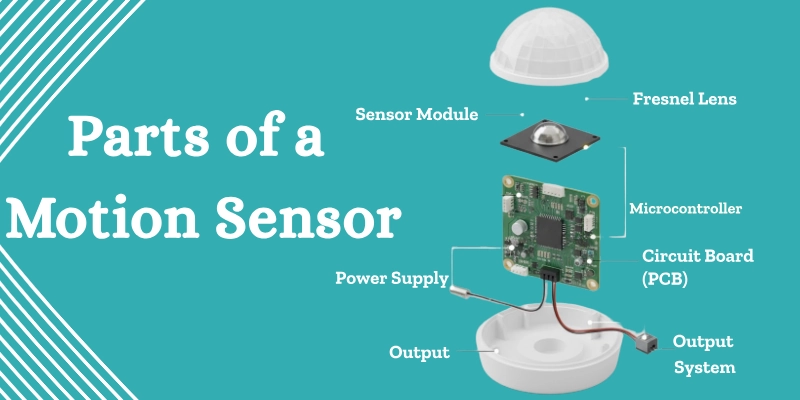
Here are the main motion sensor components in simple words:
- Sensor Module: This is the main part that actually senses movement.
- Lens or Antenna: Helps focus or extend the detection area, depending on the sensor type.
- Circuit Board: Processes the signals and decides if movement is detected.
- Power Supply: Can be a battery or direct electricity to run the sensor.
- Output System: Sends signals to a light, alarm, camera, or another connected device.
Uses of Motion Sensors in Daily Life
Motion sensors are all around us, making life safer, smarter, and more convenient. Here are some common motion sensor uses:
- Home Security: Motion sensors help trigger alarms and CCTV cameras when someone moves in restricted areas.
- Smart Homes: They turn on lights, fans, or other devices automatically when you enter a room.
- Public Places: Automatic doors at malls, offices, and hospitals open when someone approaches.
- Energy Saving: Lights and appliances turn off when no one is nearby, saving electricity.
- Safety: Parking sensors in cars detect obstacles and prevent accidents.
These motion detector applications show how motion sensors improve convenience and security in everyday life.
Example:
Supermarkets use motion sensors to open their sliding doors automatically.
Advantages and Disadvantages of Motion Sensors
Motion sensors are very useful, but like all devices, they have both benefits and drawbacks. Here’s a simple look at them:
| Aspect | Advantages | Disadvantages |
| Function | Detects movement automatically | May trigger false alarms |
| Security | Enhances safety | Sensitive sensors may be tricky |
| Convenience | Smart home automation | Needs proper installation |
| Cost | Saves energy and effort | Some types are costly |
| Reliability | Works anytime motion occurs | Limited in extreme conditions |
This table makes it easy to understand the benefits and drawbacks of motion sensors.
Motion Sensor vs Light Sensor
Sometimes people confuse motion sensors with light sensors, but they are different. Here’s a simple comparison:
| Feature | Motion Sensor | Light Sensor |
| Detects | Movement | Brightness or light level |
| Use | Security, automation | Streetlights, phones, gadgets |
| Trigger | Motion detected | Changes in light intensity |
This makes it easy to understand the difference between motion and light sensors.
Tips for Choosing the Right Motion Sensor
Choosing the right motion sensor makes a big difference in performance and convenience. Here are some easy tips:
- Choose the right type: Pick PIR, microwave, or dual-technology sensors based on your needs.
- Check detection range and angle: Make sure the sensor can cover the area you want.
- Look for waterproof features: Important for outdoor use to withstand rain and dust.
- Ensure compatibility: Make sure it fits with your smart home system.
- Choose energy-saving models: They help reduce electricity usage and save money.
Following this simple motion sensor buying guide can help you pick the best motion sensor for your home or office.
Conclusion
In short, a motion sensor is a device that detects movement using heat, light, or sound. It helps devices like lights, alarms, cameras, and smart home systems react automatically to motion.
Motion sensors are used everywhere, in homes, offices, public places, and smart devices, to improve security, convenience, and energy efficiency.
Motion sensors make our lives smarter, safer, and more energy-efficient.
FAQs
Confused about how motion sensors work? Get simple answers in our FAQ section!
Motion sensors are used in homes, offices, and public places. They help control lights, alarms, and security cameras automatically. They are also used in smart home devices and automation systems.
People use motion sensors to make life easier and safer. They help save energy by turning devices on or off automatically. They are also used to improve security and automate smart devices.
Devices like automatic lights, security alarms, CCTV cameras, and smart home gadgets use motion sensors. They can also be found in automatic doors and parking sensors in cars. Motion sensors help these devices respond quickly to movement.
The main purpose of a sensor is to detect changes in the environment. It senses things like movement, light, heat, or sound. Then it sends signals to devices to take action automatically.
A motion sensor, also called a motion detector, can tell if someone is moving. It works using heat, light, or sound signals. This makes it useful for lights, alarms, and security systems.
The most common motion sensor is the PIR (Passive Infrared) sensor. It detects heat from humans and animals. It is widely used in home lights and basic security systems.
To set a motion sensor, first choose the right type and location. Adjust the detection range and angle according to your needs. Finally, connect it to a device like a light, alarm, or smart system.
The other name for a motion sensor is a motion detector. Both terms are used to describe devices that detect movement nearby. They are interchangeable in home, office, and security contexts.
There are four main types of motion sensors: PIR, ultrasonic, microwave, and dual-technology sensors. Each type works differently using heat, sound, or radio waves. They are chosen based on the area and purpose of use.
A motion sensor has five main components: sensor module, lens or antenna, circuit board, power supply, and output system. The sensor module detects movement. The other parts help process signals and control devices like lights or alarms.






- Be Respectful
- Stay Relevant
- Stay Positive
- True Feedback
- Encourage Discussion
- Avoid Spamming
- No Fake News
- Don't Copy-Paste
- No Personal Attacks
- Be Respectful
- Stay Relevant
- Stay Positive
- True Feedback
- Encourage Discussion
- Avoid Spamming
- No Fake News
- Don't Copy-Paste
- No Personal Attacks
