What is a GPS Device? Full Guide with Examples and Uses
Published: 14 Apr 2026
Have you ever wondered “what is a GPS device” and how it helps you find your way? In simple terms, it’s a tool that uses satellites to show your exact location anywhere on Earth. It helps you navigate from one place to another quickly and accurately.
This technology has become a part of everyday life. It helps drivers avoid wrong turns, supports delivery tracking, and improves safety in emergencies. You can find it in common gadgets like smartphones, cars, and smartwatches.
In the past, people depended on paper maps and directions. Today, GPS has completely changed navigation, making it faster, easier, and more reliable than ever before.
What is a GPS Device?
A GPS device (short for Global Positioning System) is an electronic tool that uses signals from satellites to determine your exact location on Earth. In simple terms, it helps you know where you are and guides you to where you want to go.
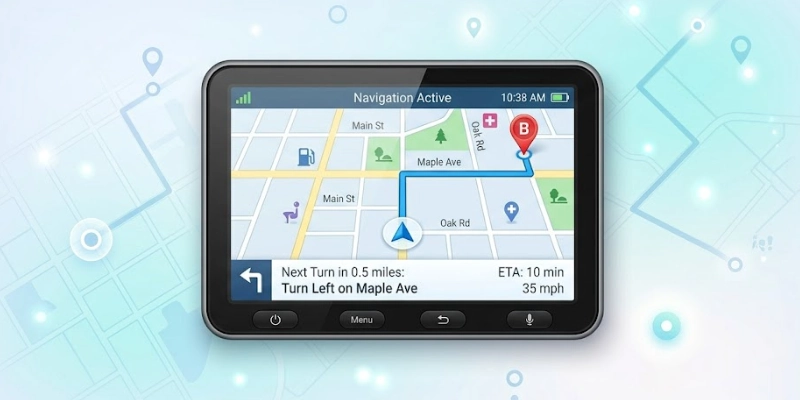
Technically, it works by receiving signals from multiple satellites and calculating your position using coordinates like latitude and longitude. This process happens in real time, providing accurate and up-to-date location information, often within a few meters.
- It provides the exact location (latitude & longitude).
- It works anywhere with clear satellite visibility.
- It is used for navigation and tracking purposes.
- It is available in portable and built-in devices.
- It can store or transmit location data for different uses.
How Does a GPS Device Work?
A GPS device works by receiving signals from satellites that orbit the Earth. These satellites constantly send information about their position and time. The device uses this data to find your exact location.
For accurate results, it usually connects to at least four satellites. This helps it measure distances more precisely and calculate your position using a method called trilateration (finding a point based on distances).
- Satellites send signals down to Earth
- The device receives signals from multiple satellites
- It calculates the distance from each satellite
- Then it determines your exact position in real time
This process happens very quickly, which is why you can see your location instantly on maps.
Main Components of a GPS System
A GPS system is made up of three main parts that work together to show accurate location information. These parts continuously communicate with each other to ensure correct positioning. Together, they help users get real-time and reliable location data anywhere on Earth.
- Space Segment (Satellites)
This includes satellites that move around the Earth. They send signals with location and time data.
- Control Segment (Ground Stations)
These are stations on Earth that monitor and control the satellites. They make sure the signals stay accurate.
- User Segment (GPS Devices)
This includes all GPS devices like phones, car navigation systems, and smartwatches. These devices receive satellite signals and show the user’s location.
Types of GPS Devices
GPS devices come in different types based on how they are used, designed, and what functions they perform. Each type serves a different purpose depending on user needs.
By Usage
This category explains GPS devices based on who uses them and for what purpose.
- Personal GPS devices (used by individuals for travel and daily navigation)
- Commercial GPS devices (used by businesses for delivery and transport tracking)
- Military GPS devices (used for defense, security, and tactical operations)
By Design
This category shows different GPS devices based on their physical form and structure.
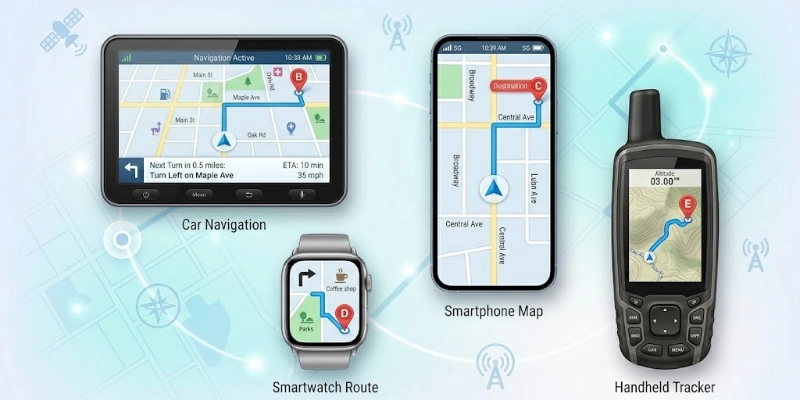
- Handheld GPS devices (portable and easy to carry)
- Vehicle GPS trackers (installed in cars, bikes, or trucks for tracking)
- Smartphone GPS (built into mobile phones for navigation apps)
- Wearable GPS devices (found in smartwatches and fitness trackers)
By Functionality
This category explains GPS devices based on how they work and what they do.
- Real-time GPS trackers (show live location updates)
- Passive GPS trackers (store location data for later use)
- GPS navigation systems (help users find routes and directions)
This classification helps us understand how GPS technology is used in different areas of life, from personal travel to professional tracking systems.
Key Features of a GPS Device
A GPS device comes with several useful features that help users track their location and navigate easily.
- Real-time tracking: This feature shows the live location of a person or vehicle as it moves.
- Route navigation: It helps users find the best and shortest path to their destination.
- Speed and distance tracking: It measures how fast you are moving and how far you have traveled.
- Mapping and directions: It displays maps and gives step-by-step guidance for travel.
- Connectivity (apps, internet, SIM-based tracking): It connects with mobile apps or networks to share and update location data.
These features make GPS devices useful for travel, safety, and everyday navigation.
Uses of GPS Devices
GPS devices are used in many areas of life. They help people, businesses, and services find locations, track movement, and improve safety.
Everyday Uses
This includes daily activities where GPS helps people move and find places easily.
- Navigation in cars and phones: helps drivers and users reach destinations
- Finding locations and directions makes it easy to search for places and routes
Business Uses
Businesses use GPS to manage transport and improve delivery systems.
- Fleet management: tracks company vehicles for better control
- Delivery tracking: shows the real-time status of parcels and goods
Safety & Security
GPS is important for protection and emergency support.
- Tracking vehicles and people: helps monitor movement for safety
- Emergency services: assist rescue teams in locating people quickly
Other Uses
GPS is also used in several advanced fields.
- Agriculture: helps farmers manage fields and farming equipment
- Aviation and marine navigation: supports aircraft and ship travel
- Fitness tracking: used in smartwatches to monitor running and activity
GPS technology has become useful in almost every part of modern life.
Advantages of GPS Devices
GPS devices offer many benefits that make travel, tracking, and navigation easier in daily life.
- Accurate positioning: Provides precise location information using satellite signals
- Saves time and fuel: Helps choose the shortest and fastest routes
- Easy navigation: Guides users step by step to reach their destination
- Improves safety: Helps in tracking and emergency situations
- Global coverage: Works almost anywhere in the world with satellite access
These advantages make GPS devices very useful for both personal and professional use.
Limitations of GPS Devices
GPS devices are very useful, but they also have some limits that affect their performance.
- Signal issues: GPS may not work properly inside buildings, underground areas, or tunnels.
- Battery dependency: Most GPS devices need power, so they stop working when the battery runs out.
- Privacy concerns: Location tracking can raise privacy issues if data is misused.
- Best accuracy: GPS works best when it has a clear view of the sky and satellites.
These limitations show that GPS is helpful, but not perfect in every situation.
GPS Device vs GPS System
To understand GPS technology better, it is important to know the difference between a GPS system and a GPS device. Both work together, but they are not the same thing. The GPS system is the main network in space, while the GPS device is what users use to get location information.
| Feature | GPS System | GPS Device |
| Meaning | A network of satellites that sends location signals | An electronic receiver that gets signals from satellites |
| Function | Provides global positioning data | Shows location and navigation details to the user |
| Location | Located in space (satellites + ground control) | Used on Earth (phones, cars, trackers) |
| Role | Works as the main system | Works as the user tool |
| Example | Satellite network | Smartphone, car GPS, smartwatch |
This difference helps us understand that the GPS system provides the data, while the GPS device uses that data for everyday use.
Examples of GPS Devices
GPS technology is used in many common devices that people use every day for navigation and tracking.
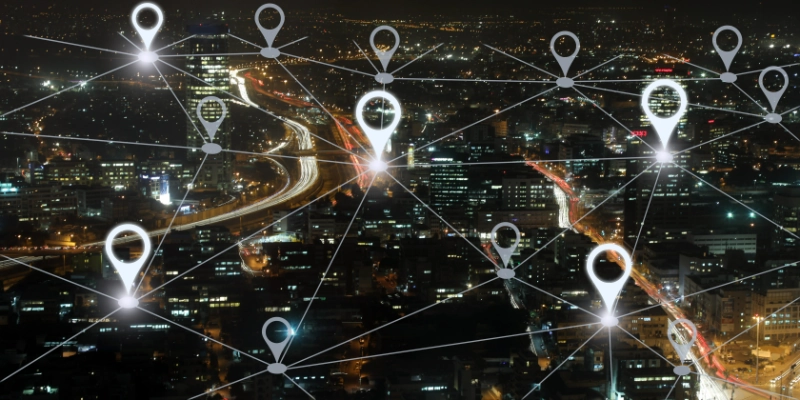
- Smartphones: Most mobile phones have built-in GPS for maps, directions, and location sharing.
- Car navigation systems: These systems help drivers find routes, avoid traffic, and reach destinations easily.
- Smartwatches: Wearable devices that use GPS to track fitness activities like running and walking.
- Dedicated GPS trackers: Special devices used to track vehicles, pets, or valuable items in real time.
These examples show how GPS devices are widely used in both personal and professional life.
Brief History of GPS
GPS technology was developed by the U.S. Department of Defense to support military navigation and operations. In its early stage, it was mainly used for defense purposes to improve location accuracy and tracking.
Later, during the 1980s and 1990s, GPS was made available for civilian use, allowing the public to benefit from this advanced technology. Over time, it became more accurate and accessible.
Today, GPS is widely used around the world in smartphones, vehicles, aviation, and many other everyday applications.
Future of GPS Technology
The future of GPS technology is expected to be more advanced, accurate, and widely used in smart systems.
- Improved accuracy: Future GPS systems will provide even more precise location tracking, reducing errors to a very small range.
- Integration with AI and IoT: GPS will work with artificial intelligence and smart devices to give faster and smarter location-based services.
- Smart cities and autonomous vehicles: GPS will play a key role in self-driving cars and smart city systems for better traffic and transport management.
Overall, GPS technology will continue to grow and become an important part of modern digital life.
Conclusion
A GPS device is a simple but powerful tool that helps people find locations, navigate routes, and track movement using satellite signals. It works with the GPS system to provide accurate and real-time positioning in everyday life.
Today, GPS technology is an important part of modern living. It is used in smartphones, cars, smartwatches, and many tracking systems, making travel safer, faster, and more convenient.
As technology continues to grow, GPS will become even more advanced and useful in the future.
Explore GPS-enabled devices to make your travel, safety, and daily navigation easier and smarter.
FAQs
Still have questions? Check our FAQs to get quick and clear answers about GPS devices and how they work.
A GPS device is used to find exact locations and get directions. It also helps in tracking vehicles, people, and objects in real time. It is widely used in smartphones, cars, and navigation systems.
A GPS device is usually accurate within a few meters. Its accuracy depends on signal strength and environmental conditions. Open areas give better accuracy than crowded or covered places.
Yes, GPS works without internet because it uses satellite signals. However, the internet is often used to load maps and extra details. Basic location tracking still works even without mobile data.
GPS is the system that provides location data using satellites. Navigation uses this data to guide users on routes and directions. In simple words, GPS gives location, and navigation gives guidance.
GPS usually does not work well indoors due to weak satellite signals. Buildings and roofs block or reduce signal strength. It works best in open areas with a clear view of the sky.
Many devices like smartphones, cars, and smartwatches use GPS. It is also used in fitness trackers and dedicated tracking devices. These devices help with navigation and real-time tracking.
Yes, GPS signals are completely free for everyone to use. You do not need to pay to access basic GPS services. Only some advanced apps or services may have charges.
GPS may show the wrong location due to weak or blocked signals. Tall buildings, trees, or bad weather can affect accuracy. Restarting the device or moving to an open area often helps.





- Be Respectful
- Stay Relevant
- Stay Positive
- True Feedback
- Encourage Discussion
- Avoid Spamming
- No Fake News
- Don't Copy-Paste
- No Personal Attacks
- Be Respectful
- Stay Relevant
- Stay Positive
- True Feedback
- Encourage Discussion
- Avoid Spamming
- No Fake News
- Don't Copy-Paste
- No Personal Attacks
